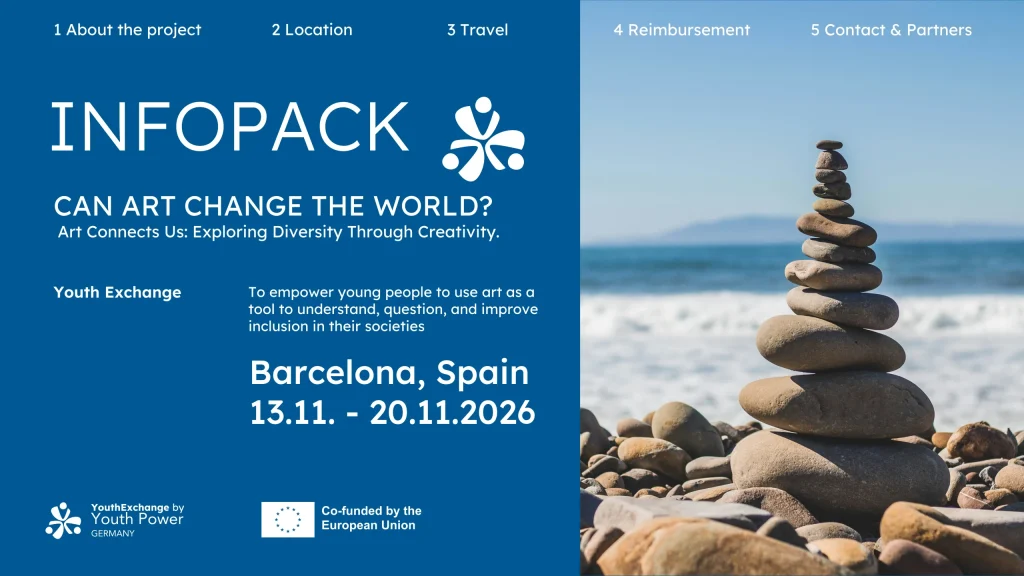
Art Connects Us: Exploring Diversity Through Creativity.
European societies are becoming more diverse, yet many young people experience growing polarisation, discrimination, and feelings of not belonging. Young people with fewer opportunities, whether because of disability, migration background, socioeconomic situation, gender identity, sexual orientation, or where they live, are often the least visible in public debate. At the same time, young people frequently find it difficult to talk about these topics directly, especially across languages and cultures.
Art offers a different way in. It lets people express experiences they may not have words for, see familiar realities from new angles, and imagine alternatives together. Throughout history, artists have used their work to question injustice and propose new ways of living together. This youth exchange uses art both as a research tool to perceive how our societies work, and as a creative tool to imagine and communicate how they could become more inclusive.
Location: Barcelona, Spain.
When: 13th – 20th November 2026
Deadline Application: 17th October 2026
Eligibility is limited to applicants from: Germany, Spain, Italy, Portugal and Poland.
Eligible age: 16 to 30 years old. ( youth leader over 30 years old)
Accommodation and food covered – 3 meals – 2 coffee breaks
Travel reimbursement: costs will be reimbursed according to the Erasmus+ Distance Calculator. ( Infopack )
European societies are becoming more diverse, yet many young people experience growing polarisation, discrimination, and feelings of not belonging. Young people with fewer opportunities, whether because of disability, migration background, socioeconomic situation, gender identity, sexual orientation, or where they live, are often the least visible in public debate. At the same time, young people frequently find it difficult to talk about these topics directly, especially across languages and cultures.
Art offers a different way in. It lets people express experiences they may not have words for, see familiar realities from new angles, and imagine alternatives together. Throughout history, artists have used their work to question injustice and propose new ways of living together. This youth exchange uses art both as a research tool to perceive how our societies work, and as a creative tool to imagine and communicate how they could become more inclusive.
The exchange is guided by one open question: Can art change the world? Around it sit three supporting questions that shape the week: How do we perceive our societies, and who is visible or invisible in them? What barriers to inclusion do young people experience today? What can art do to make our communities more inclusive, and what are its limits?
The overall aim is to empower young people to use art as a tool to understand, question, and improve inclusion in their societies. More specifically, participants will explore their own identities and perspectives and how these shape the way they see others; develop awareness of different forms of exclusion and discrimination in today’s Europe; experiment with a range of artistic methods as ways of observing, expressing, and communicating social issues; strengthen intercultural dialogue, empathy, and cooperation in a diverse group; create collective artworks that share their vision of inclusive societies with the wider public; and leave with concrete ideas for using art in their own communities.
The exchange follows non-formal education principles and uses an arts-based, experiential research approach. Participants act as researchers of their own societies: they observe, collect impressions, test ideas through art, and reflect on what they discover. The week moves through four phases.
Daily reflection groups and a personal research journal (What did I create? What did I notice? What changed in me or in others?) keep the learning visible, and support the Youthpass process.
Participants gain competences in cultural awareness and expression, social and civic engagement, communication in foreign languages, and learning to learn, all of which connect directly to the Youthpass key competences. Tangible results would include a public exhibition or performance, a collection of artworks, a digital gallery or short documentary of the process, a zine or booklet of methods other youth workers can reuse, and local follow-up actions in each partner country.
The Infopack provides all the essential details you need to know about the youth exchange, including the project goals, location, travel arrangements, accommodation, and important contact information. Make sure to read it carefully to be fully prepared for the event
The application deadline is 17th October 2026!
Below is the Google Form link to the application form. We wish you the best of luck and hope to see you soon in our educational activities!